What makes a rainbow?
- brianaull
- Jun 12, 2021
- 5 min read
Updated: Jun 21, 2025
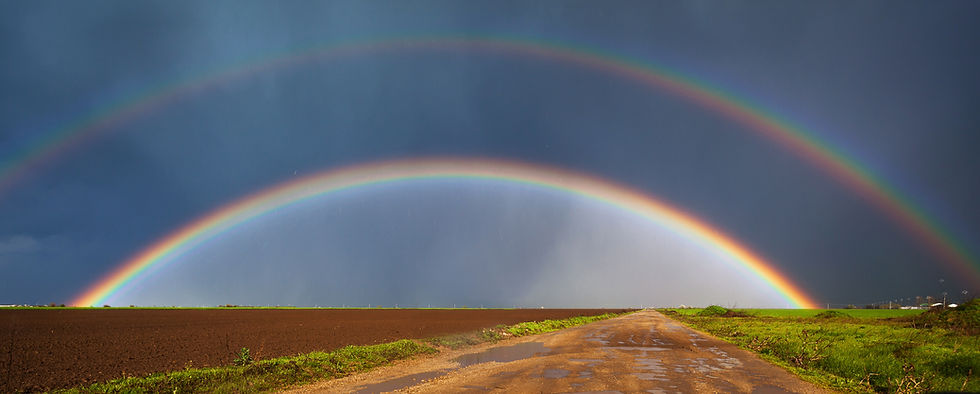
You stand with the sun warming your back, looking at distant clouds. Water droplets in the air reflect the sunlight back at you, breaking it up into its spectrum of colors. We sometimes see a double rainbow, as in the picture above. The outer rainbow is fainter than the main one, and the colors are in reverse order. Notice also all the white light underneath the arc of the main rainbow. We see the rainbow arcs at particular angles with respect to the incoming sun rays. What's going on here?
Reflection and refraction
When a ray of light in air or vacuum hits the surface of a denser medium such as water or glass, some light gets reflected, while the rest continues. The light that continues into the denser medium is slowed down by a factor known as the index of refraction. For example, water has an index of refraction of about 1.33, so the speed of light in water is 1.33 times slower than in a vacuum. If the light enters the medium at an angle, the light beam bends or refracts at the surface . Both reflection and refraction are shown in the picture below of light entering a semicircular piece of glass..

Image of light refracted by glass from Zátonyi Sándor (ifj.) Fizped, CC BY-SA 3.0 via Wikimedia Commons
Reflection is nature's way of avoiding nonsensical physical behavior. When the light enters a slower medium, the energy flow also slows down. To avoid an energy pileup at the surface, some of the energy flowing in from the faster medium has to be turned back, creating a reflected beam.
A light beam is also a series of waves, and physical waves avoid nonsensical physical behavior. Water waves, for example, can't have a vertical wall like the one shown below. Such a wall would collapse. Crest must align with crest, and trough with trough!

When light waves move into the slower medium they slow down and compress closer together, as shown in the animation below. In order to keep crest-to-crest and trough-to-trough alignment at the boundary, the light wave must change direction. So, refraction avoids discontinuities analogous to the vertical water wall shown above.

Water droplets
Water vapor in clouds or fog forms tiny spherical droplets. Sunlight can enter a droplet, get reflected inside of it, and then come back out again. The picture below shows an example with a single reflection inside the drop. In each encounter with the drop's surface, the light is partially reflected, partially transmitted.

We can trace the path of light rays through the droplet. Below shows seven rays of sunlight coming in horizontally from the right. The farther off-center the incoming ray, the greater the dip angle of the reflected ray that emerges from the drop.

Or at least this is true up to a certain point. Ray 7 represents the maximum amount of dip angle. If we go beyond ray 7, the dip angle decreases again. The picture below shows rays 7 and 8. Ray 8 is beyond the point of maximum dip and reflects back closer to horizontal than ray 7.

Here's a video that shows how the path of the ray changes as the incoming ray moves off-center (and it also shows different colors taking slightly different paths, and we'll get to that later).
If we use a typical refractive index value of 1.335 for water, the maximum dip angle is just under 42 degrees. Notice that none of this depends on how big the drop is. We can predict everything from angles.
Cones of light
My pictures are cross sections. In three dimensions, the droplet reflects light into a cone-shaped region. As shown below, the reflected light concentrates in directions just inside the surface of the cone, and not as much in the cone's interior. Why? Look back at the diagram with the seven reflected rays. The interior rays, such as 1, 2, and 3, diverge. The light rays spread out thinly. The rays at and just below the maximum dip angle, such as 6 and 7, are much closer to being parallel. So, the light intensity concentrates along that direction.

Rainbow colors
Now we can understand how the rainbow happens. The white light from the sun is a mixture of many wavelengths, each of which we perceive as a color. The refractive index of water is slightly different for different wavelengths. Blue light bends slightly more than red light, both entering and leaving the droplet. The picture below shows how this breaks up ray 7 into different colors. Red has the largest dip angle, blue the smallest. The strong reflections at the edge of the cone occur at slightly different angles for different colors. In the cone's interior the reflected colors completely overlap, producing white light.

Now let's look at the observer's view of a rainbow when there are many water droplets at different heights and distances. As shown below, the observer with the sun directly at her back will see different colors at different angles. The red light, by virtue of having the largest maximum dip angle, will reach her eyes from drops located at the highest elevation angle. Below that, she'll see the green and then the blue. At even lower elevation angles, the colors completely overlap so that she sees white light.

So with a bit of knowledge about reflection, refraction, and geometry, we've predicted the main features of the primary rainbow: the view angle where it occurs, the order of the colors, and the presence of the white light underneath it. We also see that the rainbow is not something located at a particular place in the sky. Each color comes from many droplets located along a particular angle.
Second rainbow
Some fraction of the light takes a second bounce inside the droplet. Here's a picture of the paths of these light rays that emerge from the droplet after two internal reflections. A ray that hits the drop near dead center, such as ray 1, emerges out the back side. The farther off-center the incoming ray, the more the emerging light ray tilts toward the front of the droplet. As in the case of the first rainbow, the trend continues up to a certain point and then reverses. Ray 7 represents this point of maximum deflection.

Here's a video that shows the trend.
Now we look just at ray 7 and show it breaking up into colors from refraction.

The rays emerging from the droplet in the above picture are about 51 degrees below horizontal. The second reflection inside the droplet flips the colors into reverse order.
The theory predicts the features of the second rainbow. We see it at about 51 degrees from the sun rays and with the colors reversed.
Other rainbows form by three or four reflections inside the droplet. But these are very faint because light is lost at each partial reflection from the droplet's surface.
Enjoy the beauty of the rainbow, and enjoy the beauty of science.


Comments